Connecting the pieces: the Global Think-tank on Steatotic Liver Disease at the World Health Summit 2026

On the opening day of the World Health Summit, the Global Think-tank on Steatotic Liver Disease brought policymakers, clinicians, patient advocates and researchers together around a key question: what will it take to move steatotic liver disease (SLD) from an isolated condition into integrated metabolic health, noncommunicable disease (NCD) and universal health coverage (UHC) pathways?
The session, “The Future of Metabolic Health, Liver Disease and Related NCDs: Reimagining Care Pathways and Policies for the Next Decade,” drew a full room in Berlin, along with participants online. It looked 10 years ahead, imagining a patient pathway from diagnosis and linkage to care through to treatment.
The panel

Moderated by Prof. Jeffrey V. Lazarus, Director of the Global Think-tank on Steatotic Liver Disease, the panel brought together H.E. Dr Hanan Mohamed Al Kuwari, Advisor to the Prime Minister for Public Health Affairs, Qatar; Prof. Gauden Galea, University of Malta; Achim Kautz, patient advocate, International Liver Cancer Movement; and Johanna Ralston, CEO, World Obesity Federation.
The timing gave the discussion urgency. In May 2026, the World Health Assembly adopted its first resolution on SLD, calling on countries to bring liver health into their national NCD strategies. The panel kept returning to the distance between that commitment and its delivery.
Prof. Galea put it plainly: “a health system being in place is not enough. It has to be robust.”
What the room told us
Participants voted anonymously on Slido throughout the session, and the panellists responded to the results as they came in.
Asked to name the biggest barrier to integrating liver health into metabolic care in one word (45 responses from 38 participants), participants most often answered cost, ignorance and unawareness, alongside silos, funding, overspecialisation and misconceptions about liver health. Gaps in knowledge ranked alongside gaps in money: integration depends on understanding as much as on resources.
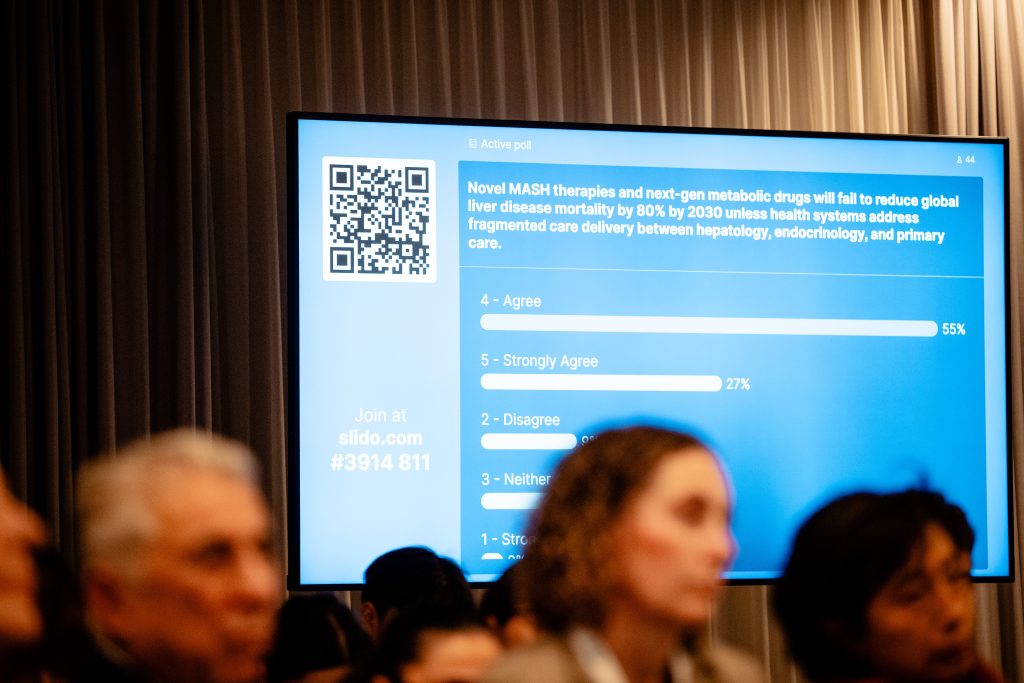
The strongest result confirmed the session’s central premise. 82% (n=44) agreed that novel MASH therapies and next-generation metabolic drugs will fail to reduce global liver disease mortality by 80% by 2030 unless health systems address fragmented care across hepatology, endocrinology and primary care. No participant strongly disagreed.
Other results were less settled. Just under half (49%, n=43) agreed that UHC frameworks currently fail to recognise liver disease as a core NCD, while a third (33%) were undecided. That uncertainty is itself a finding: many people working in global health are unclear where liver health stands in coverage frameworks today.
Expectations for national action were similarly split. Five months after the WHA resolution, 49% (n=47) expected their country or region to have a dedicated SLD strategy, or to have integrated SLD into national NCD policy, by 2030. Another 24% disagreed that it would happen and 28% were unsure.
On technology, 55% (n=51) agreed that by 2030, AI and automated electronic health record algorithms will transform SLD care by flagging high-risk liver fibrosis in primary care before symptoms appear. Nearly a quarter disagreed.
Key takeaways
The discussion pointed to four priorities for health systems:
- Use the 2026 WHA resolution to bring liver health into national NCD policies, UHC targets and strategies on commercial determinants, from food environments to alcohol regulation.
- Build SLD tracking into national NCD monitoring, with standardised, publicly reported metrics and a consensus continuum of care.
- Shift care upstream with eHealth and AI-driven risk stratification that identifies high-risk fibrosis earlier.
- Realign fragmented delivery models to enable multi-specialty care and equitable access to prevention and therapies.
Keeping the liver in the conversation
To extend the discussion beyond the session, the Think-tank shared Connect the pieces, a three-day crossword booklet on liver and metabolic health, with more than 100 summit participants. Its three puzzles, Systems, Policy and Place, led to an invitation to join MASH Cities, the Think-tank’s initiative to embed metabolic liver health into urban health agendas.

Watch the full session
*The session was supported by Novo Nordisk and Madrigal Pharmaceuticals.
*Percentages are rounded and may not total 100%. Sample sizes (n) refer to the number of votes cast in each anonymous Slido poll.